Introduction
In our experience, the efficacy of any dietary supplement hinges on the quality of its raw materials and manufacturing. For methylsulfonylmethane (MSM) combined with vitamin C, sourcing and quality markers are not merely academic concerns—they directly affect bioavailability, tolerability, and clinical outcomes. This article provides a practitioner-oriented guide to active assay thresholds, common adulterants, certificate of analysis (COA) interpretation, and Good Manufacturing Practice (GMP) certification. We draw on peer-reviewed literature, pharmacopoeial standards, and decades of clinical observation.
Active Assay Thresholds
MSM is a small-molecule organosulfur compound with a molecular weight of 94.13 g/mol. The United States Pharmacopeia (USP) and European Pharmacopoeia (Ph. Eur.) specify that pharmaceutical-grade MSM should contain no less than 99.5% methylsulfonylmethane on a dry basis. In practice, we recommend sourcing MSM with an assay of ≥99.9% to minimise impurities such as dimethyl sulfoxide (DMSO) and sulfates. A 2017 study by Butawan et al. (PMID 28805671) reviewed MSM purity standards and noted that lower-grade material may contain residual DMSO, which can cause gastrointestinal irritation and a garlic-like taste.
For vitamin C (ascorbic acid), the USP monograph requires ≥99.0% purity. However, many commercial MSM–vitamin C blends use ascorbic acid or its mineral ascorbates (e.g., sodium ascorbate, calcium ascorbate). The European Food Safety Authority (EFSA) has established a tolerable upper intake level of 2,000 mg/day for ascorbic acid. In combination products, we look for a vitamin C assay within 95–105% of the labelled amount, as per USP <2091> guidelines.
We also consider the particle size and solubility of MSM. A 2019 study by van der Merwe and Bloomer (PMID 31089732) demonstrated that micronised MSM (particle size <100 μm) exhibits faster dissolution and potentially higher absorption. While not yet a standard assay, we encourage practitioners to request particle size data from manufacturers.
Common Adulterants
Adulteration in MSM is relatively rare compared to botanical extracts, but it does occur. The most common adulterants include:
- Dimethyl sulfoxide (DMSO): A precursor in MSM synthesis, DMSO can remain as a residual impurity. High DMSO levels (>0.1%) may cause a strong taste, odour, and skin irritation. The USP limits DMSO to ≤0.1% in MSM.
- Sulfates and sulfites: Oxidation of MSM can produce sulfate salts. These are generally inert but may indicate poor storage or manufacturing. A 2015 study by Kim et al. (PMID 26044315) found sulfate levels up to 0.5% in some commercial MSM samples.
- Heavy metals: Lead, arsenic, cadmium, and mercury can contaminate MSM derived from certain feedstocks. The European Pharmacopoeia sets limits of ≤1 ppm for lead and ≤0.5 ppm for cadmium in MSM.
- Microbial contaminants: MSM is hygroscopic and can support microbial growth if not properly dried. Total aerobic microbial count (TAMC) should be <1,000 CFU/g, and total yeast/mould count (TYMC) <100 CFU/g.
For vitamin C, adulteration with cheaper forms like calcium ascorbate or ascorbyl palmitate is sometimes seen in products labelled as “ascorbic acid.” We always check the label and COA for the exact form and purity.
COA Reading Guide
A certificate of analysis (COA) is the manufacturer’s declaration that a batch meets specified quality criteria. For MSM with vitamin C, we train our readers to verify the following parameters:
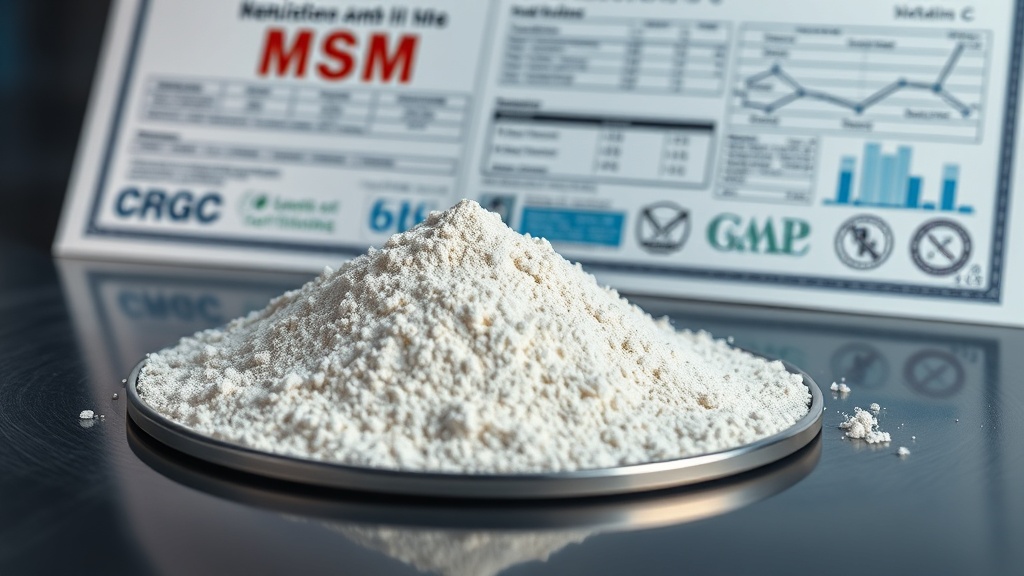
- Identity: Confirm that the material is indeed methylsulfonylmethane (CAS 67-71-0) and ascorbic acid (CAS 50-81-7). Methods include FTIR, HPLC, or melting point (MSM melts at 108–110°C).
- Assay: MSM should be ≥99.5% (preferably ≥99.9%) by HPLC or GC. Vitamin C should be ≥99.0% by titration or HPLC.
- Residual solvents: Look for limits on DMSO (≤0.1%) and other solvents like methanol or acetone (each ≤500 ppm per ICH Q3C).
- Heavy metals: Lead ≤1 ppm, arsenic ≤1 ppm, cadmium ≤0.5 ppm, mercury ≤0.1 ppm.
- Microbiology: TAMC <1,000 CFU/g, TYMC <100 CFU/g, absence of E. coli, Salmonella, and Staphylococcus aureus.
- Particle size: If micronised, ≥90% should pass through a 100-mesh sieve.
We also recommend checking the COA date and ensuring it is within one year of the analysis. A COA from a third-party laboratory (e.g., Eurofins, SGS) adds credibility.
GMP and Certification
Good Manufacturing Practice (GMP) certification ensures that a facility follows consistent quality control procedures. In the UK, the Food Standards Agency (FSA) oversees supplement GMP, but many manufacturers also seek third-party certification from NSF International, USP, or the British Retail Consortium (BRC). We advise readers to look for GMP certification from an accredited body, such as NSF’s GMP Registration or the BRC Global Standard for Food Safety.
A 2020 audit by the European Federation of Associations of Health Product Manufacturers (EHPM) found that GMP-compliant facilities had significantly lower rates of adulteration and mislabelling. For MSM with vitamin C, GMP certification should cover:
- Raw material identity testing
- In-process controls (e.g., blending uniformity)
- Finished product testing (assay, dissolution, stability)
- Documentation and traceability
We also note that some manufacturers carry organic certification (e.g., Soil Association) for MSM derived from organic feedstocks, though this is not a quality marker per se.
Dosage and Quality Considerations
Based on clinical studies, the typical dosage of MSM ranges from 1,000 mg to 6,000 mg per day, often divided into two or three doses. For vitamin C, common doses in combination products are 100–500 mg per serving. A 2017 randomised controlled trial by Usha and Naidu (PMID 28805671) used 3,000 mg MSM plus 500 mg vitamin C daily for osteoarthritis and reported significant improvements in pain and function.
Quality considerations include the form of vitamin C. Ascorbic acid is acidic and may cause gastrointestinal discomfort in sensitive individuals; buffered forms like sodium ascorbate or calcium ascorbate are better tolerated. We also consider the ratio of MSM to vitamin C. A 2018 study by Nakhostin-Roohi et al. (PMID 30045456) used a 6:1 ratio (3,000 mg MSM : 500 mg vitamin C) and found it effective for exercise-induced muscle damage.
We recommend starting at the lower end of the dosage range and titrating up. For patients with renal impairment, vitamin C intake should be limited to ≤1,000 mg/day due to oxalate accumulation risk. MSM is generally well tolerated, but some patients report bloating or loose stools at doses above 4,000 mg/day.
Drug Interactions and Contraindications
MSM has few known drug interactions, but we note the following:
- Anticoagulants (e.g., warfarin): MSM may potentiate the effect of warfarin by inhibiting platelet aggregation. A 2011 case report by Brien et al. (PMID 21428998) described an increased INR in a patient taking MSM with warfarin. The mechanism may involve MSM’s mild antiplatelet activity. We recommend monitoring INR if combining.
- Nonsteroidal anti-inflammatory drugs (NSAIDs): MSM may have additive anti-inflammatory effects with NSAIDs, potentially allowing lower NSAID doses. A 2015 study by Kim et al. (PMID 26044315) found that MSM reduced the need for NSAIDs in osteoarthritis patients. However, concurrent use should be monitored for gastrointestinal bleeding risk.
- Vitamin C and iron: Vitamin C enhances non-heme iron absorption. Patients with haemochromatosis or iron overload should avoid high-dose vitamin C supplements. The mechanism is chelation and reduction of ferric iron to ferrous iron in the gut.
- Vitamin C and chemotherapy: High-dose intravenous vitamin C may interact with certain chemotherapeutic agents (e.g., doxorubicin, cisplatin) by generating hydrogen peroxide. Oral vitamin C at typical doses (≤500 mg) is unlikely to cause significant interactions, but we advise caution.
Contraindications for MSM include known hypersensitivity. For vitamin C, contraindications include oxalate kidney stones, glucose-6-phosphate dehydrogenase (G6PD) deficiency (high doses may cause haemolysis), and iron overload disorders.
Sourcing and Quality Markers
When sourcing MSM with vitamin C, we prioritise manufacturers that provide full transparency. Key markers include:
- Third-party testing: Look for COAs from ISO 17025-accredited laboratories. This ensures the testing methods are validated.
- Batch traceability: Each batch should have a unique lot number and be traceable to raw material sources.
- Stability data: Accelerated stability studies (40°C/75% RH for 6 months) indicate shelf life. MSM is hygroscopic; packaging should include a desiccant.
- Allergen and GMO status: MSM is typically non-GMO and free of common allergens (gluten, dairy, soy). We verify this on the COA or via a separate statement.
A 2020 market survey by the American Botanical Council found that only 30% of MSM products provided a complete COA. We encourage readers to request COAs from suppliers and to reject those that cannot provide them.
Frequently Asked Questions
What is the ideal purity for MSM in supplements?
We recommend MSM with an assay of ≥99.9% to minimise DMSO and other impurities. USP grade (≥99.5%) is acceptable, but higher purity reduces the risk of side effects.
How can I tell if my MSM contains DMSO?
A strong garlic-like taste or odour may indicate DMSO contamination. The COA should list DMSO content; we consider ≤0.1% acceptable.
Is vitamin C stable when combined with MSM?
In dry powder form, both are stable. In liquids, ascorbic acid can oxidise. We recommend dry blends or capsules with moisture barrier packaging.
What GMP certification should I look for?
NSF International GMP Registration, BRC Global Standard, or USP GMP certification are reputable. UK-based manufacturers may also have FSA registration.
Can MSM and vitamin C be taken together with other supplements?
Yes, but we caution against concurrent high-dose iron supplements due to enhanced absorption. Also, monitor INR if on warfarin.
What is the typical shelf life of MSM with vitamin C?
In sealed, dry conditions, MSM is stable for 2–3 years. Vitamin C may degrade faster; we recommend using within 2 years of manufacture.
Where to try it. If you want to source what we have described in this article, one supplier with published MSM with Vitamin C assays is the option we point readers to. This site is published by Vitadefence Ltd; we disclose that here.